
Getting people to use the network regularly changed what we needed from the connections between nodes.
When airtime filled up
LoRa was inexpensive and gave us useful reach. Once a few people were active at the same time, however, the available airtime filled surprisingly quickly. Traffic backed up and the backbone connections became choppy.
We had been working to make the network comfortable enough for daily use. That meant the links between nodes needed to carry the combined activity of several users.
The change to HaLow
Moving those links to Wi-Fi HaLow removed the bottleneck we had been experiencing. In our installations, it gave us comparable range, with some links reaching farther than our previous LoRa connections.
We still use LoRa where its cost and reach make it useful for the last mile. HaLow carries traffic between nodes.
A node assembly
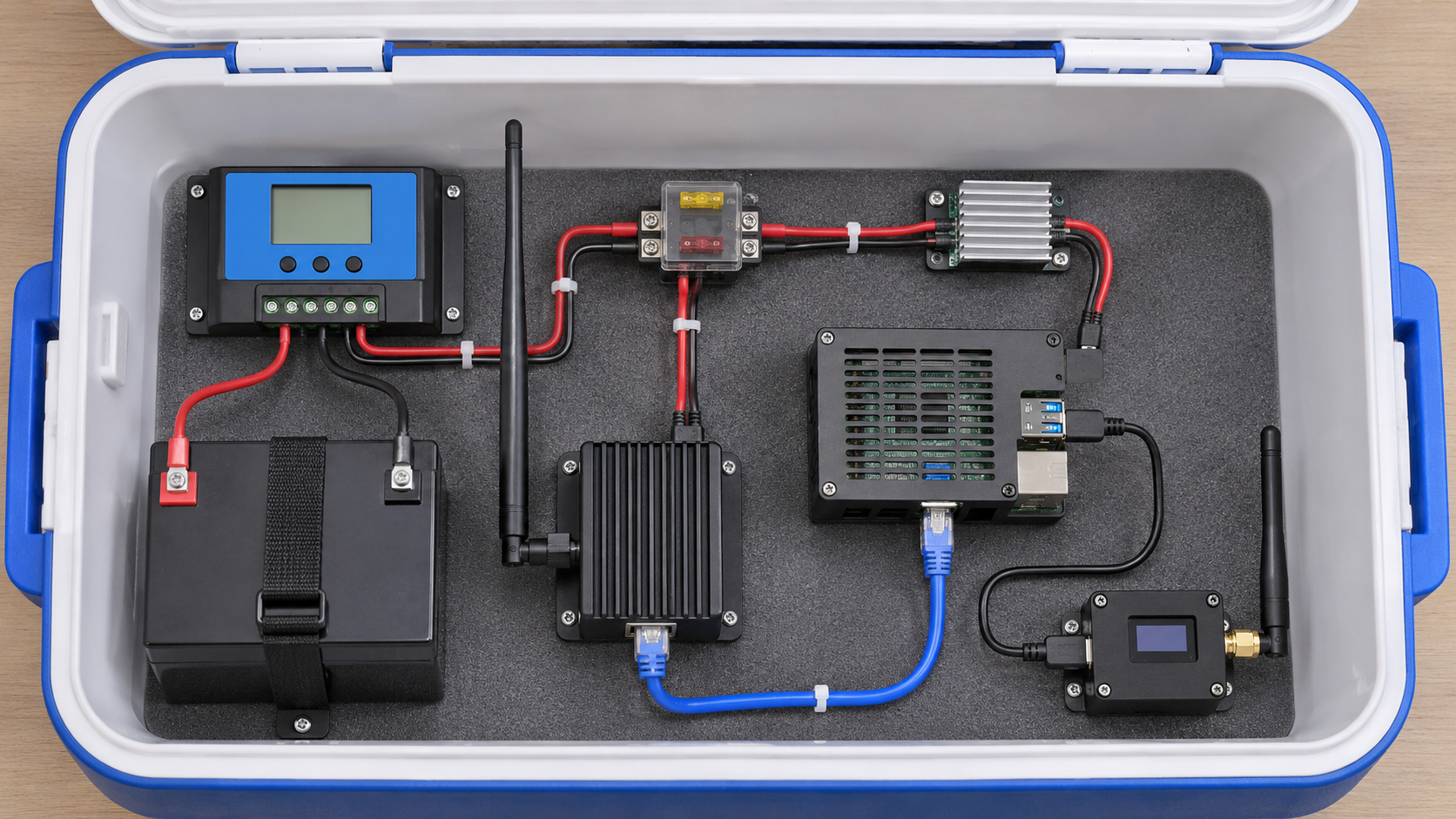
The illustrated assembly puts a Raspberry Pi, battery, charge controller and radios inside an inexpensive cooler. The HaLow bridge connects to the Pi through Ethernet. A USB connection joins the LoRa node to the Pi.
This arrangement brings the backbone and local radio access together at the same node.